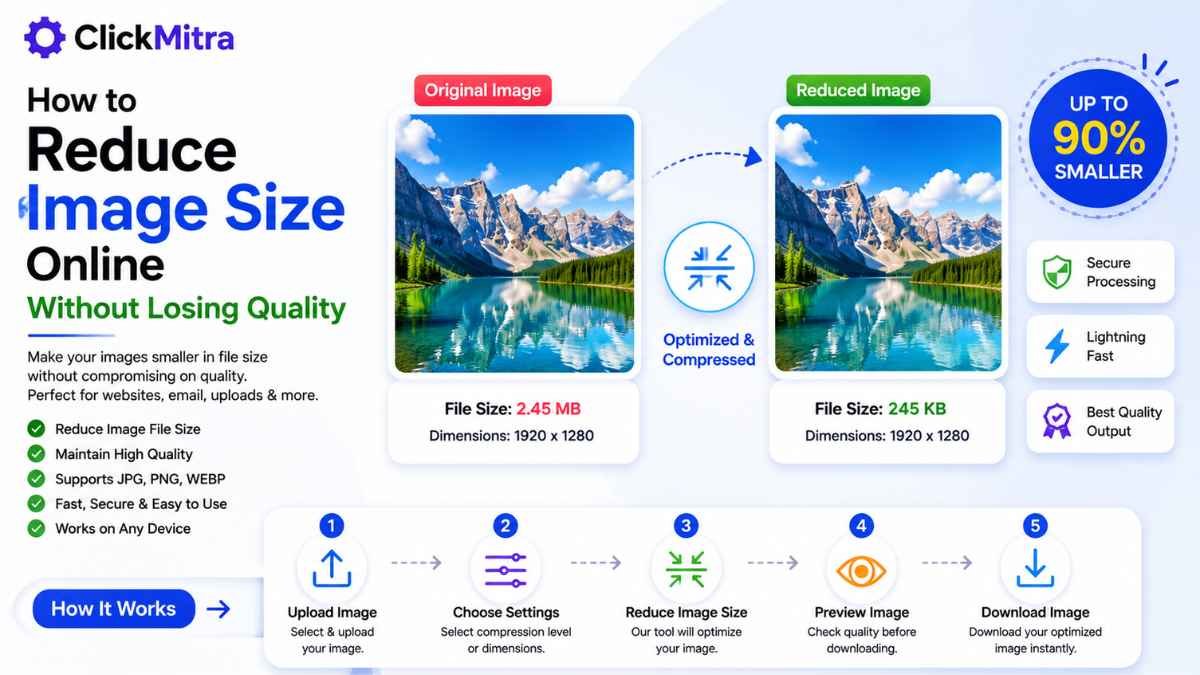
How to Reduce Image Size Online Without Losing Quality
Learn how to reduce image size online without losing quality. Resize and compress JPG, PNG and other images for websites, email, uploads and sharing.
Large image files can be difficult to upload, share, store, and use on websites. High-resolution photos and graphics can quickly become several megabytes in size, which may create problems when a website has a file-size limit.
If you're wondering How to Reduce Image Size Online Without Losing Quality, an online image compression or resizing tool can help you make images smaller without unnecessarily affecting their appearance.
In this guide, we'll explain how to reduce image size online, the difference between resizing and compression, how to reduce image file size for websites and email, and how to maintain good image quality.
Compress Image Size Online Here
How to Reduce Image Size Online Without Losing Quality
The easiest way to make an image smaller is to use an online image size reduction tool.
The basic process is:
- Open an online image size tool.
- Select your image.
- Upload the image.
- Choose the available size or compression option.
- Process the image.
- Download the smaller image.
If you're searching for How to Reduce Image Size Online Without Losing Quality, the important thing is to reduce unnecessary file data while keeping the image dimensions and visual quality suitable for your intended use.
Why Reduce Image Size?
Reducing image size can be useful in many situations.
You may want to reduce an image when:
- A website has an upload limit.
- An email attachment is too large.
- You need faster website loading.
- You want to save storage space.
- You need to upload images to an online form.
- You want to share images more easily.
- Your phone or computer contains many large images.
A smaller image file is generally easier to upload, transfer, and store.
Image Size vs Image File Size
Before reducing an image, it's important to understand that "image size" can mean two different things.
Image Dimensions
Dimensions refer to the width and height of an image.
For example:
4000 × 3000 pixels
Reducing the dimensions to:
2000 × 1500 pixels
makes the image physically smaller in terms of resolution.
File Size
File size refers to how much storage the image occupies.
For example:
5 MB → 1 MB
This can be achieved through image compression or other optimization techniques.
Depending on what you need, you may want to change the dimensions, compress the image, or do both.
How to Reduce Image Size Online Step by Step
Step 1: Select Your Image
Choose the image you want to make smaller.
You can use photographs, screenshots, graphics, product images, or other supported image files.
Before processing an important image, keep a copy of the original.
Step 2: Open an Online Image Tool
Open ClickMitra's image size or compression tool.
An online tool allows you to process the image directly through your browser without installing additional software.
Step 3: Upload the Image
Select the image from your computer, phone, or other device.
Once uploaded, the tool can process the image according to the available options.
Step 4: Choose the Appropriate Option
Depending on the tool, you may be able to resize or compress the image.
If you need the image to fit specific pixel dimensions, use resizing.
If you mainly want a smaller file, compression may be more appropriate.
Step 5: Process the Image
Start the image-processing operation.
The tool will create a smaller version of the original image.
Step 6: Download and Check the Result
Download the processed image and open it.
Check:
- Image sharpness
- Text readability
- Overall dimensions
- File size
- Important details
This is especially important when trying to follow How to Reduce Image Size Online Without Losing Quality.
How to Reduce Image File Size Without Losing Quality
If your main problem is a large file rather than excessive dimensions, image compression can help.
Compression removes unnecessary or redundant data from an image to reduce the amount of storage it requires.
However, there is a limit to how much an image can be compressed before visible quality changes become noticeable.
For the best result, compress the image gradually and compare the output with the original.
Does Reducing Image Size Affect Quality?
It can, depending on how the image is reduced.
If you dramatically reduce the dimensions of a high-resolution image, fine details may disappear.
Similarly, aggressive compression can introduce artifacts or make an image look blurry.
This is why How to Reduce Image Size Online Without Losing Quality is not simply about making the file as small as possible.
The goal should be to find a practical balance between file size and visual quality.
How to Reduce Image Size for a Website
Large images can increase the amount of data a website needs to load.
Before uploading an image to a website, consider:
- The actual dimensions required on the page.
- The image format.
- The file size.
- The level of compression.
- Whether the image contains unnecessary detail.
For example, uploading a 5000-pixel-wide photograph when the website only displays it at 1200 pixels wide may be unnecessary.
Resizing it before uploading can significantly reduce the amount of data.
How to Reduce Image Size for Email
Large images can also cause problems when sending email attachments.
If an image is too large, you can resize or compress it before attaching it.
For example:
Original image: 8 MB
Optimized image: 1.5 MB
The exact reduction depends on the original image and the compression settings.
If image quality is important, always check the smaller version before sending it.
How to Reduce Image Size on Mobile
You don't need a computer to make an image smaller.
You can use an online image tool through your smartphone's browser.
The process is similar:
- Open the image tool.
- Select the image from your phone.
- Upload it.
- Resize or compress it.
- Download the optimized image.
This can be useful when you need to upload an image to a website directly from your phone.
Resize vs Compress: What's the Difference?
These two methods are often confused.
Resizing
Resizing changes the dimensions of an image.
For example:
3000 × 2000 → 1500 × 1000
This can significantly reduce file size because the image contains fewer pixels.
Compression
Compression reduces the amount of data stored in the image.
The dimensions may remain exactly the same while the file becomes smaller.
Which One Should You Use?
If the image dimensions are much larger than necessary, resizing may be the better first step.
If the dimensions are already appropriate but the file is still too large, compression may be more suitable.
In some cases, using both methods provides the best result.
Which Image Format Should You Use?
The image format can also affect file size.
JPG
JPG is commonly used for photographs and other complex images.
It can provide relatively small file sizes while maintaining acceptable visual quality.
PNG
PNG is useful for graphics, screenshots, logos, and images that require transparency.
However, some PNG images can be considerably larger than JPG versions of similar photographs.
WebP
WebP is another modern image format that can provide efficient compression for web use.
The appropriate format depends on where and how you plan to use the image.
How to Reduce Image Size Without Making It Blurry
To maintain good quality:
- Don't reduce dimensions more than necessary.
- Avoid extremely aggressive compression.
- Keep the original image.
- Compare the processed image with the original.
- Use the appropriate image format.
- Resize images to their actual display dimensions.
If you're learning How to Reduce Image Size Online Without Losing Quality, these steps can help you avoid unnecessarily reducing image quality.
How Much Should You Reduce an Image?
There isn't one correct reduction percentage for every image.
It depends on where you're going to use it.
For example:
Website: Resize according to the displayed dimensions.
Email: Reduce the file enough to make attachment and download practical.
Social media: Follow the platform's recommended dimensions.
Online forms: Stay below the website's file-size limit.
Printing: Be more careful about reducing dimensions because print quality depends on resolution.
Can You Reduce Image Size Without Changing Dimensions?
Yes.
If you want to keep the same width and height, compression can reduce the file size while maintaining the original pixel dimensions.
For example:
4000 × 3000 pixels, 6 MB → 4000 × 3000 pixels, 2 MB
The actual result depends on the image and compression method.
Reduce Image Size Online With ClickMitra
ClickMitra provides online tools that can help you work with image files directly from your browser.
If your image is too large for an upload, email, website, or online form, you can use an image resizing or compression tool to create a more manageable version.
When following How to Reduce Image Size Online Without Losing Quality, always check the final image before replacing your original file.
Frequently Asked Questions
How to Reduce Image Size Online Without Losing Quality?
Upload your image to an online image resizing or compression tool, choose an appropriate size or compression level, process the image, and check the resulting file before downloading or sharing it.
How can I reduce image file size online?
You can use an online image compression tool to reduce the amount of data stored in an image while keeping its dimensions unchanged.
Can I reduce image size without changing dimensions?
Yes. Image compression can reduce file size while keeping the same pixel dimensions.
Does reducing image size reduce quality?
It can. The effect depends on how much you resize or compress the image. Moderate optimization can often reduce file size while maintaining good visual quality.
How do I reduce image size for a website?
Resize the image to the dimensions actually required by the website and compress it appropriately before uploading.
How do I reduce image size for email?
Resize or compress the image before attaching it to your email. Check the resulting file size and image quality before sending it.
Can I reduce image size on my phone?
Yes. Online image tools can be accessed through a mobile browser, allowing you to resize or compress images directly from your smartphone.
Should I resize or compress an image?
If the image dimensions are unnecessarily large, resizing can help. If the dimensions are already appropriate but the file is too large, compression may be better.
Does converting PNG to JPG reduce image size?
It can, particularly for photographs, but the result depends on the image. JPG also uses lossy compression and does not support transparency.
Conclusion
Large image files can be inconvenient when you're uploading, sharing, emailing, or storing them. Resizing and compression can help make images more manageable without unnecessarily sacrificing visual quality.
The best approach depends on the image and its purpose. If the dimensions are too large, resize them. If the dimensions are appropriate but the file is still large, compress the image.
If you're searching for How to Reduce Image Size Online Without Losing Quality, ClickMitra's online image tools can help you create smaller, more practical image files directly from your browser.